
Reconciliation
Reconciliation is Hostwright’s core loop: deterministic, observable, and designed to fail closed.
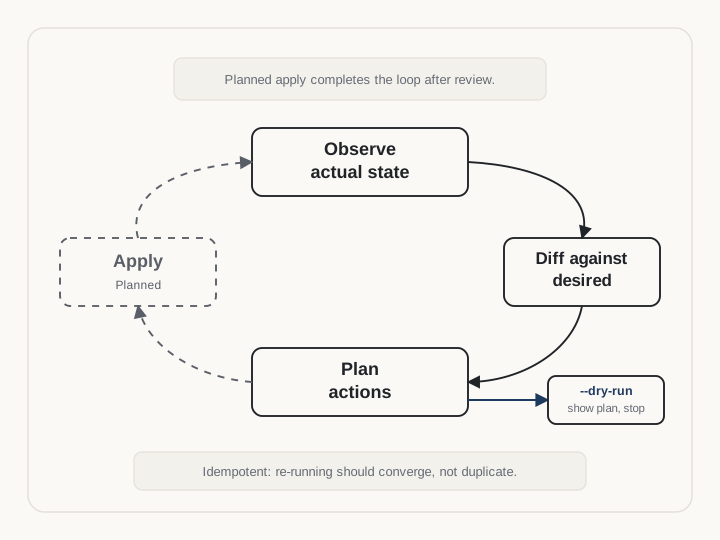
The loop
Section titled “The loop”- Load desired state from the manifest.
- Observe runtime state through the RuntimeAdapter.
- Compute drift.
- Produce a dry-run plan with a deterministic hash.
- Mutate only through a confirmed lifecycle plan.
- Record events.
The planner maps the supported manifest subset to runtime-shaped desired state, accepts optional adapter-shaped observed state, runs policy checks, and emits typed drift records, typed issues, typed planned actions, and a deterministic plan hash.
Plan and mutate are separate commands
Section titled “Plan and mutate are separate commands”hostwright planrenders desired-state and policy diagnostics. It does not perform live runtime observation by default, and it says so explicitly in its output.hostwright up,down,run,start,stop,restart,rm, andupdateeach recompute their own plan against a live observation, require a matching--confirm-planhash, persist operation intent before mutation, then execute the plan’s ready nodes with bounded parallelism.applyis a compatibility alias for a confirmedupplan. See Lifecycle commands.hostwright cleanupis separate from the lifecycle commands, with its own dry-run token gate, and never removes anything a lifecycle command would manage. See the safety model.hostwrightd --foregroundruns the observe, plan, and record loop continuously. It never calls a lifecycle command itself; mutation stays with an operator running one explicitly. See Daemon.
Drift cases
Section titled “Drift cases”The planner detects:
- missing desired services;
- unmanaged observed services;
- stopped, exited, failed, and missing lifecycle states;
- image drift, port drift, mount drift;
- unhealthy or unknown health state where policy requires health;
- duplicate observed identities;
- unsupported unknown observed lifecycle states;
- unavailable observation.
Each drift record maps to a typed planned action (create, start, stop, restart, remove, or update) scoped to one service. A plan can carry more than one such action; what makes an action executable is passing every policy and precondition check, not being the only action in the plan. An action that fails a check is still rendered in the plan, marked unavailable and blocked from execution, so the operator can see exactly what would not happen and why.
Correctness requirements
Section titled “Correctness requirements”- Planning is deterministic: same inputs, same plan, same hash.
- Desired state and observed state remain separate inputs.
- Drift must be explainable: every record carries a typed reason.
- Plan rendering must not expose raw secrets.
- Mutation must require plan-hash confirmation.
- Operation intent must be persisted before mutation.
- Failures must be observable through events.
- Managed restart requires Hostwright ownership, live observed running state, a fresh persisted unhealthy health result, and recovery records.